

Jump straight to the section you need.
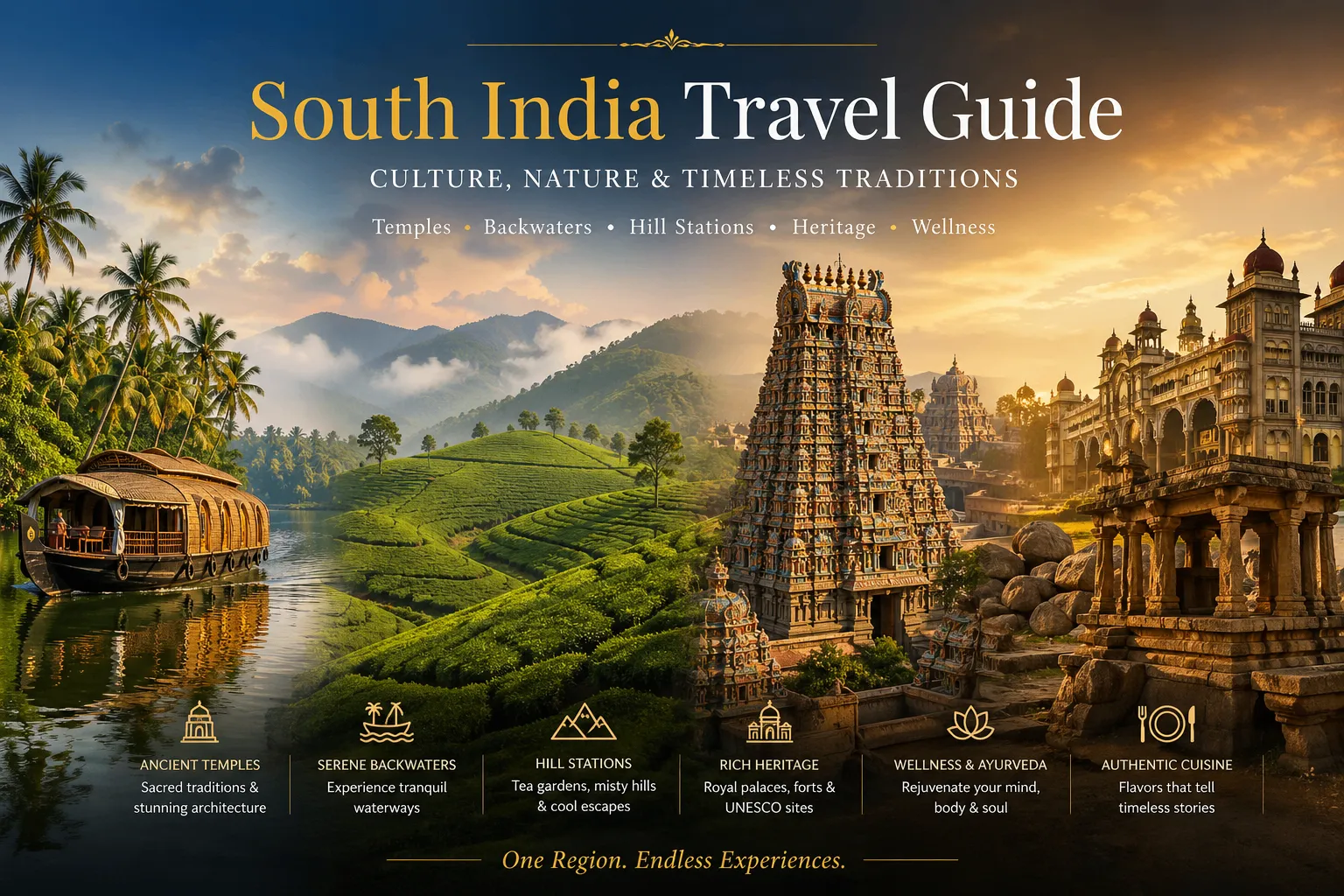
South India Travel Guide – Temples, Hills & Backwaters
Best Places, Routes, Best Time to Visit and Practical Advice for Tamil Nadu, Karnataka and Kerala
South India rewards slower travel, longer stays and careful routing. This guide covers the three states most travellers combine in one trip, Tamil Nadu, Karnataka and Kerala, with real drive times, how many days you need, the best time to go and what to expect at temples. Andhra Pradesh and Telangana are culturally rich but are usually planned separately.
What people remember is rarely a single monument. It is the early morning at the temple in Madurai, a winding drive through the Western Ghats, or a quiet day on the Kerala backwaters. The key to a good trip is to plan around travel time rather than distance, and to change hotels less often than you think you should. Our Jaipur-based team builds journeys on that principle as private South India tours, tailored to your dates and pace.
Plan Your South India Tour →
South India at a Glance
- Core states: Tamil Nadu (temples and heritage), Karnataka (royal cities, ruins and hills) and Kerala (backwaters and nature).
- Ideal duration: 10 to 14 days for two or three states; 7 days works for one state.
- Best time to visit: October to March overall, though Tamil Nadu’s coast is wettest in November and December.
- Getting there: Fly into Chennai, Bengaluru or Kochi, and use one for arrival and another for departure.
- Getting around: A private car with driver for most routes, with flights or trains for long gaps.
- UNESCO sites: The Great Living Chola Temples, Mahabalipuram, Hampi and Pattadakal.
- Hill stations: Ooty, Kodaikanal, Coorg and Munnar.
- Who it suits: Culture and heritage lovers, couples, families and slow-travel fans.
Why Visit South India
South India feels different from the north: more rooted in daily ritual, greener and slower. Temples here are active places of worship rather than museums, and the three main states each have their own rhythm. Tamil Nadu is structured and temple-driven, Karnataka blends heritage with varied landscapes, and Kerala is slow and nature-focused.
- Living temples: Rituals continue through the day, especially at dawn and in the evening.
- Heritage in many forms: Dravidian temples, royal palaces, ancient ruins and colonial towns.
- Varied landscapes: Coast, plains, tea and coffee hills, and backwaters.
- Food: Distinct regional cooking, from Chettinad to Kerala seafood.
- Wellness: Easy access to Ayurveda, yoga and coastal retreats.
Best Places to Visit in South India
Distances feel longer than they look on the map, so choose fewer places and give each one time. The lists below group the main destinations by state, each linked to a full sightseeing guide.
Tamil Nadu – Temples, Heritage and Hill Stations
- Chennai: A practical entry point with museums, a long beach and easy day trips to the coast.
- Mahabalipuram: A UNESCO-listed shore temple and rock carvings, best seen early before the day visitors arrive.
- Kanchipuram: An ancient temple town famous for its silk weaving.
- Pondicherry: A former French colony with a quiet promenade, colonial streets and the Aurobindo Ashram.
- Chidambaram: The Nataraja temple, one of South India’s most important Shiva shrines.
- Thanjavur: The Brihadisvara Temple, part of the UNESCO-listed Great Living Chola Temples.
- Trichy: The vast Srirangam temple complex and the Rock Fort.
- Madurai: The Meenakshi Temple, best experienced in the early morning and evening rituals.
- Tiruvannamalai: A mountain-side temple town with a strong spiritual atmosphere.
- Ooty and Kodaikanal: Hill stations with tea gardens and cool air, though the roads take longer than expected, especially at weekends and in the monsoon.
Karnataka – Royal Cities, Ruins and Quiet Routes
- Bengaluru (Bangalore): A modern gateway city with gardens, and the usual start or end of a Karnataka route.
- Mysore: The illuminated palace, markets and sandalwood, with the city at its liveliest in the early evening.
- Coorg: Coffee estates, forest drives and a slow pace, best enjoyed by staying a night or two.
- Hampi: A UNESCO-listed city of ruins spread across a boulder-strewn landscape. Allow at least two days, because the sites are further apart than they look.
- Badami, Aihole and Pattadakal: Early temple architecture, with Pattadakal listed by UNESCO.
- Hassan (Belur and Halebidu): Finely carved Hoysala temples.
- Nagarhole and Bandipur: Wildlife safaris in the forests of the Western Ghats.
Kerala – Backwaters, Hills and Beaches
- Kochi (Cochin): A historic port with Fort Kochi, Chinese fishing nets and Kathakali evenings.
- Munnar: Tea plantations, misty valleys and cool air.
- Thekkady: Periyar Tiger Reserve, spice plantations and lake boat rides.
- Alleppey and the backwaters: Canals, villages and the classic overnight houseboat cruise.
- Trivandrum and Kovalam and Varkala: The southern capital and the beaches nearby.
For more detail, see our Kerala travel guide. Rameswaram and Kanyakumari in the far south can be added to a route on request.
How Many Days Do You Need for South India?
Fourteen days is the sweet spot for a multi-state trip, and ten is the minimum for two states. Plan by driving time rather than distance, and keep hotel changes to a minimum. Day counts include arrival and departure.
- 7 days – Tamil Nadu: Chennai (2 nights), Mahabalipuram (1), Thanjavur (1) and Madurai (2). A temple-focused introduction.
- 7 days – Karnataka: Bengaluru (1 night), Mysore (2), Coorg (2) and Bengaluru (1). Royal cities and coffee country.
- 10 days – Tamil Nadu and Kerala: Chennai (1 night), Mahabalipuram (1), Thanjavur (1), Madurai (2), Thekkady (1), Alleppey houseboat (1) and Kochi (2). Temples followed by backwaters.
- 14 days – the classic route: Chennai (2 nights), Mahabalipuram (1), Pondicherry (2), Thanjavur (1), Madurai (2), Thekkady (1), Munnar (2), Alleppey houseboat (1) and Kochi (1). Heritage first, then a slower Kerala finish.
- 17 to 18 days: Add Trichy, a longer stay in Munnar and extra time in Kochi, as in our Best of South India tour.
Kerala works best in the second half of a trip, when the slower pace is welcome after a run of temple towns. If you want Hampi and Badami, look at a Karnataka-focused route instead, since Hampi is a long drive from Mysore and combines better with Bengaluru and Badami.
Get Your Free South India Itinerary →
How to Reach South India and Get Around
- By air: Chennai, Bengaluru and Kochi are the main international and domestic gateways. Flying into one and out of another avoids backtracking.
- By road: A private car with driver is the most flexible way to cover temple towns, hill stations and heritage sites that don’t follow train or bus timetables.
- By train: Reliable between major cities such as Chennai, Mysore and Coimbatore, but not ideal for full sightseeing circuits.
- Domestic flights: Useful for long gaps, such as moving between Kerala and Karnataka, or Chennai and Kochi.
Approximate road distances and drive times
| Route | Distance | Drive time |
|---|---|---|
| Chennai to Mahabalipuram | About 60 km | 1.5 hours |
| Mahabalipuram to Pondicherry | About 100 km | 2 to 2.5 hours |
| Pondicherry to Thanjavur | About 180 km | 4 hours |
| Thanjavur to Madurai | About 190 km | 4 hours |
| Madurai to Thekkady | About 140 km | 4 to 5 hours |
| Thekkady to Munnar | About 110 km | 3.5 to 4 hours |
| Munnar to Kochi | About 130 km | 4 to 4.5 hours |
| Bengaluru to Mysore | About 145 km | 3 to 3.5 hours |
| Mysore to Coorg | About 120 km | 3 to 3.5 hours |
| Bengaluru to Hampi | About 340 km | 6 to 7 hours |
| Hampi to Badami | About 140 km | 3 to 3.5 hours |
Times vary with traffic and the winding hill roads, and map estimates are often optimistic in rural stretches, so allow buffer time.
Best Time to Visit South India
The best time depends on the state, because South India has two monsoons. For the wider picture, see our guide to the best time to visit India.
- December to February – the safest window: The most comfortable weather across all three states, and the peak season, so book hotels early.
- October, November and March: Good for Karnataka and Kerala. Tamil Nadu’s coast, including Chennai, receives its heaviest rain from the northeast monsoon in November and December, so January to March suits temple routes better.
- April to June – hot: The plains of Tamil Nadu and interior Karnataka are very hot. Hill stations such as Ooty, Kodaikanal, Coorg and Munnar are the better choice, with shorter drives and early starts.
- June to September – Kerala monsoon: Kerala and Coorg turn lush and quiet, and it suits Ayurveda and slow nature stays. Expect heavy rain and some travel delays. Tamil Nadu is relatively drier at this time.
Temple Etiquette and Cultural Tips
Temples in South India are active places of worship, so a few simple customs make visits easier and more respectful.
- Dress modestly: Cover shoulders and knees. Some temples ask men to remove shirts, and a light shawl or scarf is useful.
- Remove footwear: Shoes are left at stands near the entrance, so wear shoes that are easy to take off.
- Check photography rules: Outer courtyards are often fine, but the inner sanctum is usually restricted.
- Know the access rules: Some temples restrict non-Hindus from inner sanctums, so ask your guide before you go.
- Time your visit: Early morning and evening rituals are when temples come alive, rather than the middle of the day.
- Keep quiet and follow the flow: Speak softly and move with the devotees.
Festivals
- Pongal (January): Tamil Nadu’s harvest festival.
- Chithirai Festival (April or May): A major celebration at the Meenakshi Temple in Madurai.
- Onam (August or September): Kerala’s main festival, with flower carpets and boat races.
- Mysore Dasara (September or October): Ten days of processions and an illuminated palace.
- Karthigai Deepam (November or December): A festival of lights at Tiruvannamalai.
South Indian Food
- Tamil Nadu: Dosa, idli and sambar, Chettinad curries and strong filter coffee.
- Karnataka: Bisi bele bath, Mysore masala dosa and Mysore pak.
- Kerala: Sadya on a banana leaf, appam and stew, and fresh seafood in coconut curries.
- Thali meals: Unlimited vegetarian meals served on a banana leaf or steel plate across the region.
Common Mistakes and Travel Tips
- Too many places in too few days: South India looks compact on a map, but travel time cuts sightseeing hours.
- Planning by distance, not driving time: A 150 to 200 km journey can take four to six hours on hill roads.
- Changing hotels every night: Base yourself in fewer places and explore from there.
- Ignoring temple timings: Rituals and closing hours shape the day in temple towns.
- Treating the three states as alike: Each has a different rhythm, so expect a different trip in each.
- Booking the wrong season for the route: Match the state to the time of year, using the best-time section above.
- Dress for the sun: Light cotton, a hat, sunscreen and comfortable shoes.
- Carry small notes: Useful for temples, tipping and small shops.
- Consider a guide for temples and ruins: Context makes Hampi and the Chola temples far more rewarding.
- Keep Kerala for the end: It gives a restful finish after a run of busy temple towns.
For nationwide planning advice, see our India travel guide.
South India Tours and Ways to Extend Your Trip
All our tours are private and tailored, so each route below can be adjusted to your dates, pace and hotel preferences. The most useful decisions are choosing between Tamil Nadu and Karnataka for the cultural core, deciding whether Kerala is a finishing extension, and keeping hotel changes low.
- Best of South India: Tamil Nadu temples, hills and Kerala backwaters in one route.
- Sensation of South India: Bangalore, Mysore, Ooty, Madurai, Kerala hills, backwaters and Kovalam.
- Glimpses of South India: A shorter route through Chennai, Pondicherry, Madurai and Kerala.
- Temples Tour of South India, Ancient Temples Tour and Religious Tour: Routes built around the great Tamil Nadu temples.
- Cultural South India with Goa: Heritage routes in Tamil Nadu and Karnataka with Hampi and a beach finish.
- South India Wildlife Tour: Nagarhole, Bandipur and the Kerala hills for nature lovers.
- Kerala only: See our Kerala tour packages and Kerala travel guide.
- Browse everything: All our South India tour packages.
Customise Your South India Tour →
Frequently Asked Questions About South India
What is the best month to visit South India?
December to February is the most comfortable across all three states. October to March works overall, but Tamil Nadu’s coast is wettest in November and December.
How many days do you need for South India?
Ten to fourteen days covers two or three states comfortably. Seven days suits a single state, and 17 to 18 days allows a full multi-state route.
Which states are included in a South India trip?
Most itineraries cover Tamil Nadu, Karnataka and Kerala. Andhra Pradesh and Telangana are usually planned separately.
Which is better, Kerala or Tamil Nadu?
They offer different experiences. Tamil Nadu is about temples and heritage, and Kerala is slower, scenic and nature-focused. Most balanced trips include both.
What is the best way to travel around South India?
A private car with driver for most routes, with flights or trains for long gaps. Trains alone do not suit sightseeing circuits.
Can South India be covered by train only?
Not comfortably. Trains work between cities such as Chennai, Mysore and Coimbatore, but hill stations and heritage sites usually need a road transfer.
What should I wear when visiting temples in South India?
Cover shoulders and knees and wear shoes that are easy to remove. Some temples ask men to remove shirts, and some restrict non-Hindus from the inner sanctum.
Is South India safe for tourists?
Yes, it is generally considered one of the more relaxed regions of India for visitors, and the main tourist circuits are well established.
Do I need a guide in South India?
Not mandatory, but a guide adds a lot at temples, Hampi and the Chola sites, where context makes the visit more meaningful.
Can South India be combined with other parts of India?
Yes. It pairs well with Goa, and with Rajasthan or the Golden Triangle for a longer journey, using flights between regions.
Continue Exploring South India
Experience the incredible diversity of South India through private sightseeing tours featuring ancient temples, colonial towns, misty hill stations, tranquil backwaters, royal cities, and remarkable UNESCO World Heritage Sites.
India Tour Packages
Explore our most popular private India tours designed for comfort, culture, and seamless travel experiences.