

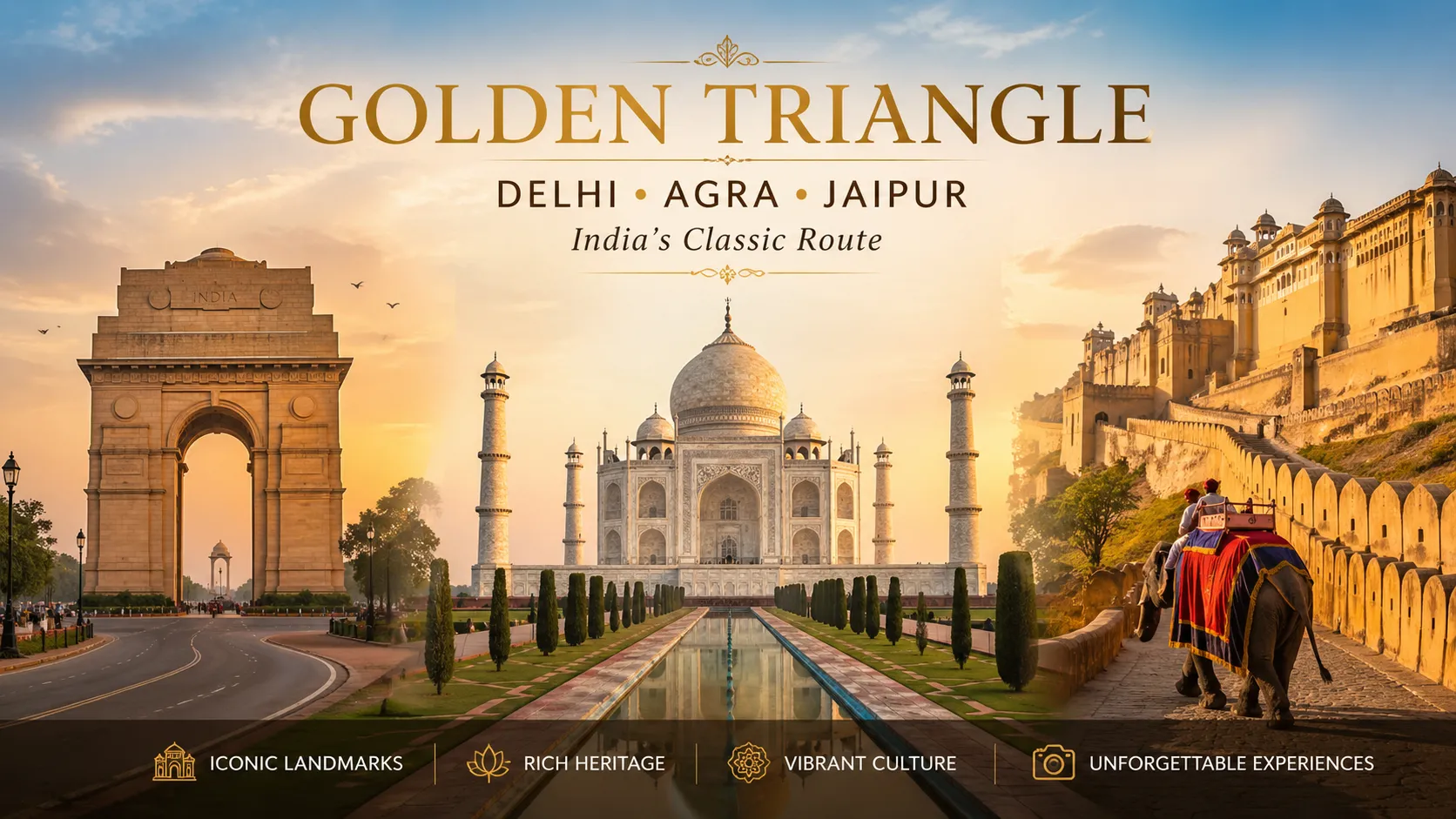
Golden Triangle Travel Guide
A simple route through Delhi, Agra & Jaipur —three cities that show completely different sides of India.🇮🇳
The Golden Triangle is usually the first route people take when they want to understand North India without overcomplicating things. It connects Delhi, Agra, and Jaipur in a loop that is easy to travel, but surprisingly layered once you’re on the ground.
You start in Delhi, where history and modern life sit side by side—old Mughal streets, wide government roads, crowded markets, quiet monuments. It feels chaotic at first, but that’s exactly what gives you a real introduction to India.
From there, the road leads to Agra. Most people come here for one reason—the Taj Mahal. And yes, it lives up to it. But Agra isn’t just the Taj. The Agra Fort, the river views, and the early morning light over the monument give the city a quieter depth than people expect.
The final stretch takes you into Rajasthan and into Jaipur. The shift is immediate. The pace slows down, the colours get warmer, and the architecture turns royal. Amber Fort on the hill, narrow bazaars inside the old city, and open courtyards of palaces give Jaipur a very different rhythm from the first two cities.
What makes this route work is not just the distance between the cities, but how different each one feels. Done in a rush, it becomes a checklist. But when paced properly, it feels like three separate journeys stitched together into one experience of India.
Explore This Golden Triangle Travel Guide
Navigate directly to the topics that interest you most and discover the history, culture, iconic landmarks, travel tips, and practical advice for planning the perfect Golden Triangle journey through Delhi, Agra, and Jaipur.
Why Travel the Golden Triangle
The Golden Triangle is often recommended for first-time visitors, but the real reason it works isn’t just because it covers famous cities. It works because it gives structure to a country that can feel overwhelming on a first visit. You move through three very different regions in a controlled loop, without worrying about complicated logistics.
Most travellers underestimate how much difference short distances can make in India. Within a few hours, everything changes—language, food, architecture, pace of life. That contrast is what makes this route more interesting than it looks on a map.
- It gives you a structured introduction to India without forcing long or complex travel days
- Each city represents a different layer of history—Mughal power in Delhi and Agra, Rajput royalty in Jaipur
- The Taj Mahal is the highlight for most travellers, but Agra’s real value comes from its early morning atmosphere and Mughal architecture
- Travel distances are short, which reduces fatigue and makes it suitable for families, first-timers, and short trips
- The route naturally shows India’s contrast—fast-paced capital, heritage monuments, and a slower royal city in Rajasthan
- It also acts as a base route that can easily extend into Ranthambore, Udaipur, Varanasi, or deeper Rajasthan
What most travellers realize only after doing this route is that the experience is not about ticking monuments—it’s about how the rhythm of the journey keeps changing every few hours. That shift is what makes the Golden Triangle surprisingly memorable even for short trips.
Understanding the three cities
The Golden Triangle works because each city changes the way you experience India. Instead of treating them as sightseeing stops, it helps to understand them as three very different travel environments.
-
Delhi – This is usually the most intense part of the journey. It’s large, noisy, and layered with history and modern life happening at the same time. First-time visitors often feel overwhelmed here, but that’s normal. Delhi gives you context for everything that follows—it shows you the scale of India before you move into smaller, more focused cities.
Most travellers need a little time to adjust here, especially to traffic, crowds, and distances. But once you settle in, Delhi becomes one of the most rewarding parts of the trip because of its depth. -
Agra – Agra feels more compact and purpose-driven. Most of the experience revolves around the Taj Mahal, but what surprises people is how the city behaves around it. Early mornings are the best time here—the city feels quieter, and the monument changes completely with light and atmosphere.
Unlike Delhi, Agra is not about variety. It’s about focus. You don’t rush here; you observe. -
Jaipur – Jaipur is often the most comfortable city for travellers. It feels planned compared to Delhi’s chaos, with wider streets, structured architecture, and a slower pace. The transition into Rajasthan is noticeable—the colours change, the atmosphere changes, even the way people interact feels different.
This is usually the city where travellers start relaxing into the journey instead of adjusting to it.
When you look at them together, these three cities don’t compete with each other—they complement each other. That contrast is what makes the Golden Triangle one of the most balanced introduction routes to India.
Things to Do Along the Golden Triangle
The Golden Triangle is not just about monuments—it’s about how each city makes you feel in its own way. Delhi feels layered and energetic, Agra feels focused and timeless, while Jaipur brings colour, craft, and rhythm into the journey.
- Watch the Taj Mahal change colour with the morning light at sunrise
- Walk through Old Delhi’s narrow lanes where history and daily life overlap
- Climb Amber Fort and understand Jaipur’s royal landscape from above
- Spend time in local bazaars instead of just passing through them
- Experience curated cultural evenings and heritage storytelling
- Explore food streets where recipes are often generations old
🍛 Food along the route
Food is one of the most honest ways to understand this journey. Each city carries its own identity on the plate—rich Mughlai flavours in Delhi and Agra, and deeply traditional Rajasthani cuisine in Jaipur.
- Delhi: rich kebabs, butter chicken, and street food culture that never really stops
- Agra: Mughlai dishes and iconic sweets that reflect royal culinary history
- Jaipur: slow-cooked Rajasthani meals built for desert life and long traditions
🎭 Culture, art & handicrafts
What makes the Golden Triangle special is not just its monuments, but the craftsmanship that still survives around them. Much of what you see is not preserved in museums—it is still made, used, and lived today.
- Agra’s marble inlay work, continuing traditions of the Taj era
- Jaipur’s block printing and blue pottery still made by local artisans
- Traditional embroidery styles passed through generations
- Folk music and storytelling that still exists in everyday spaces
How Many Days You Actually Need
This is usually the first planning question, and also where most travelers misjudge the route. On a map, the Golden Triangle looks short and simple. In reality, the experience depends entirely on how much time you give each city.
You can technically complete it in 3–4 days, but that version feels rushed. Most of the time is spent on the road, and you barely get a chance to absorb each city. It works only if your goal is quick highlights.
- 3–4 days (fast-paced trip): You will cover all three cities, but the experience feels compressed. Suitable only for travellers with very limited time.
- 5–6 days (recommended pace): This is the most balanced way to do the Golden Triangle. You get enough time in each city without feeling rushed, and travel days are manageable.
- 7–8 days (comfortable experience): Ideal for travellers who want to slow down, explore markets, enjoy food experiences, and add small detours like Fatehpur Sikri or Jaipur’s heritage walks.
In practical terms, 5 to 6 days is what most first-time travelers end up preferring. It gives enough breathing space to enjoy the journey instead of just moving from one monument to another.
🚗 How to travel between Delhi, Agra & Jaipur
The Golden Triangle looks simple on a map, but the travel experience between cities makes a big difference to how smooth your trip feels. Most travellers don’t realize that the comfort of your journey depends more on your transport choice than the distance itself.
You have three main ways to move between these cities—private car, train, or flight. Each option changes the pace of your trip in a very different way.
- Private car with driver: This is the most practical and comfortable option for most travellers. It gives you full flexibility for stops, timing, and sightseeing on the way. The roads between Delhi, Agra, and Jaipur are smooth, and travel feels controlled and stress-free.
- Train travel: A good option if you want a more local experience. Delhi to Agra is well-connected by fast trains, but timings and station transfers require more planning. It works better for budget or independent travellers.
- Flights: Not commonly needed for this route because distances are short. Flights may make sense only if you are combining Jaipur or Delhi with other cities outside the triangle.
In real travel experience, most first-time visitors prefer a private car because it reduces complexity. You don’t have to think about timings, station changes, or delays—you simply move from one city to the next at your own pace.
The route is short, but how you travel it determines whether your journey feels relaxed or rushed.
✈️ How to reach the Golden Triangle
Most international travellers begin their journey from Delhi, which is the main entry point into North India. From here, Agra and Jaipur are easily accessible by road and rail, making the route naturally connected.
- Delhi: main international airport and arrival hub
- Agra: connected via expressway and rail from Delhi
- Jaipur: well-linked by highway and short flights
🚗 Getting around the Golden Triangle
While there are multiple ways to travel between cities, the overall experience changes significantly depending on comfort and control over your journey.
- Private car: most comfortable and flexible way to experience the route
- Train: efficient but requires fixed timing and station transfers
- Flights: useful only for extensions beyond the core triangle
⚠️ Common mistakes travelers make
The Golden Triangle is one of the easiest routes to plan in India, but that simplicity is also where most first-time travelers go wrong. The mistakes are not about major decisions—they usually happen in timing, pacing, and expectations.
- Trying to cover everything in too few days: Many travelers underestimate travel time between cities and end up rushing through major sights instead of experiencing them properly.
- Expecting all three cities to feel similar: Delhi, Agra, and Jaipur are often grouped together, but each one has a completely different rhythm. Expecting uniformity leads to disappointment.
- Ignoring travel fatigue: Even though distances are not very long, moving between three cities in a short span can feel tiring if the itinerary is too tight.
- Overloading sightseeing in one day: First-time visitors often try to add too many monuments in a single day, which reduces the quality of the experience.
- Not planning early mornings properly: Some of the best moments—especially in Agra and Jaipur—happen early in the day, but many itineraries start too late.
The most successful Golden Triangle trips are not the ones that cover the most places, but the ones that allow enough time to actually experience each city without rushing.
🌤️ Best time to visit the Golden Triangle
The best time to do the Golden Triangle is not just about weather—it’s about how comfortable the entire journey feels while moving between three cities. Temperature, crowds, and visibility all play a role in how enjoyable the experience becomes.
Since this route involves regular travel between cities, the season you choose affects road comfort, walking time at monuments, and even how long you can comfortably stay outdoors.
- October to March (most recommended): This is the most comfortable period for sightseeing. Days are pleasant, travel between cities feels easier, and you can spend longer hours exploring without exhaustion.
- April to June (hot season): Temperatures rise significantly, especially in Agra and Jaipur. Travel is still possible, but early mornings and well-planned itineraries become essential to avoid peak heat.
- July to September (monsoon season): Rainfall brings a different atmosphere to the cities. Delhi and Jaipur become greener, but occasional delays in travel can happen due to weather conditions.
If your goal is a smooth and comfortable experience across all three cities, winter months remain the most balanced choice. This is also when most first-time travelers feel the route is easiest to enjoy.
Who This Journey Is Best Suited For
The Golden Triangle is not just a popular route—it’s a practical one. But it works especially well for certain types of travellers who want structure, comfort, and a balanced introduction to India.
- First-time visitors to India: This route gives a controlled introduction without overwhelming you with logistics or long-distance travel.
- Short-duration travellers: If you have limited time but still want to see India’s most iconic cities, this route fits perfectly into 5–7 days.
- Culture and history focused travellers: The route covers Mughal heritage, Rajput architecture, forts, palaces, and some of India’s most important monuments.
- Families and older travellers: Short travel distances and flexible private transport make it comfortable and easy to manage.
- Luxury and private tour seekers: The route works extremely well for tailor-made experiences with curated hotels and private guides.
If you prefer slow, remote, or offbeat travel experiences, this route may feel structured rather than adventurous. But for a first or balanced India journey, it remains one of the most reliable travel circuits.
🗺️ How the journey usually flows
Instead of thinking of the Golden Triangle as a fixed package, it helps to understand it as a flexible travel loop. The order of cities stays mostly the same, but the pace changes depending on how much time you have.
- Classic 4–5 day flow: Delhi → Agra → Jaipur → Delhi. This version covers the highlights in a short time, but travel days feel tighter and sightseeing time is limited.
- Balanced 6–7 day flow: Delhi → Agra → Jaipur. This is the most common way travellers experience the route. Each city gets enough time, and travel feels comfortable rather than rushed.
- Extended 8+ day flow: Delhi → Agra → Jaipur + nearby extensions like Ranthambore or heritage towns in Rajasthan. This version adds depth without changing the core route.
The key difference between these versions is not what you see, but how much space you give yourself between experiences. A slower pace almost always leads to a more memorable journey.
Most first-time travellers naturally end up preferring the 6–7 day structure once they understand how different each city feels in real travel conditions.
💰 What a private Golden Triangle experience typically includes
A private Golden Triangle journey is designed around comfort, flexibility, and time quality rather than fixed packages or standard itineraries. The focus is on how smoothly you move between cities and how personally the experience is shaped for you.
- Private chauffeur-driven vehicle: Dedicated car for the entire journey, allowing complete flexibility in timing, stops, and travel pace between Delhi, Agra, and Jaipur.
- Handpicked hotels: Carefully selected heritage or luxury properties based on comfort, location, and overall travel experience rather than standard listings.
- Personalized sightseeing: Flexible itineraries with private guides at major monuments, allowing you to explore at your own pace instead of fixed group schedules.
- Seamless coordination: All intercity travel, hotel arrangements, and sightseeing logistics are managed in advance to ensure a smooth, uninterrupted journey.
Instead of focusing on standard pricing structures, luxury travel in the Golden Triangle is defined by the level of comfort, privacy, and personalization throughout the journey. Every detail is adjusted based on travel style, season, and preference.
🧭 Final advice before you plan your Golden Triangle journey
The Golden Triangle is not a difficult route to plan, but it is a journey where small decisions—like pacing, timing, and travel style—make a big difference to the overall experience.
Most travellers don’t remember every monument in detail. What they remember is how the journey felt—whether it was rushed, relaxed, overwhelming, or well-balanced. That feeling is shaped entirely by how the trip is designed.
A well-planned private journey allows you to move through Delhi, Agra, and Jaipur without stress, without confusion, and without losing time on logistics. You simply experience the route as it unfolds.
If you are planning this for the first time, the key is not to fit everything in—but to experience it in the right way, at the right pace, with the right support.
Frequently Asked Questions
Is the Golden Triangle suitable for first-time visitors to India?
Yes, it is one of the most recommended routes for first-time travellers because it offers a structured introduction to India with well-connected cities and manageable travel distances.
How much time is enough for the Golden Triangle?
A comfortable experience usually takes 5 to 7 days. This allows enough time in each city without rushing through major sights.
What is the best way to travel between Delhi, Agra, and Jaipur?
A private car with driver is the most convenient option. It offers flexibility, comfort, and smooth transfers between cities.
Which city is the highlight of the Golden Triangle?
Each city offers something different—Delhi for scale and history, Agra for the Taj Mahal, and Jaipur for royal architecture and culture. The experience is about contrast, not a single highlight.
What is the best time to visit the Golden Triangle?
October to March is ideal due to pleasant weather, easier sightseeing conditions, and better overall travel comfort.
✨ Continue Exploring the Golden Triangle ✨
Explore India's most iconic destinations through curated sightseeing experiences or browse our complete collection of private day tours across Delhi, Agra, Jaipur, and beyond.
India Tour Packages
Explore our most popular private India tours designed for comfort, culture, and seamless travel experiences.