

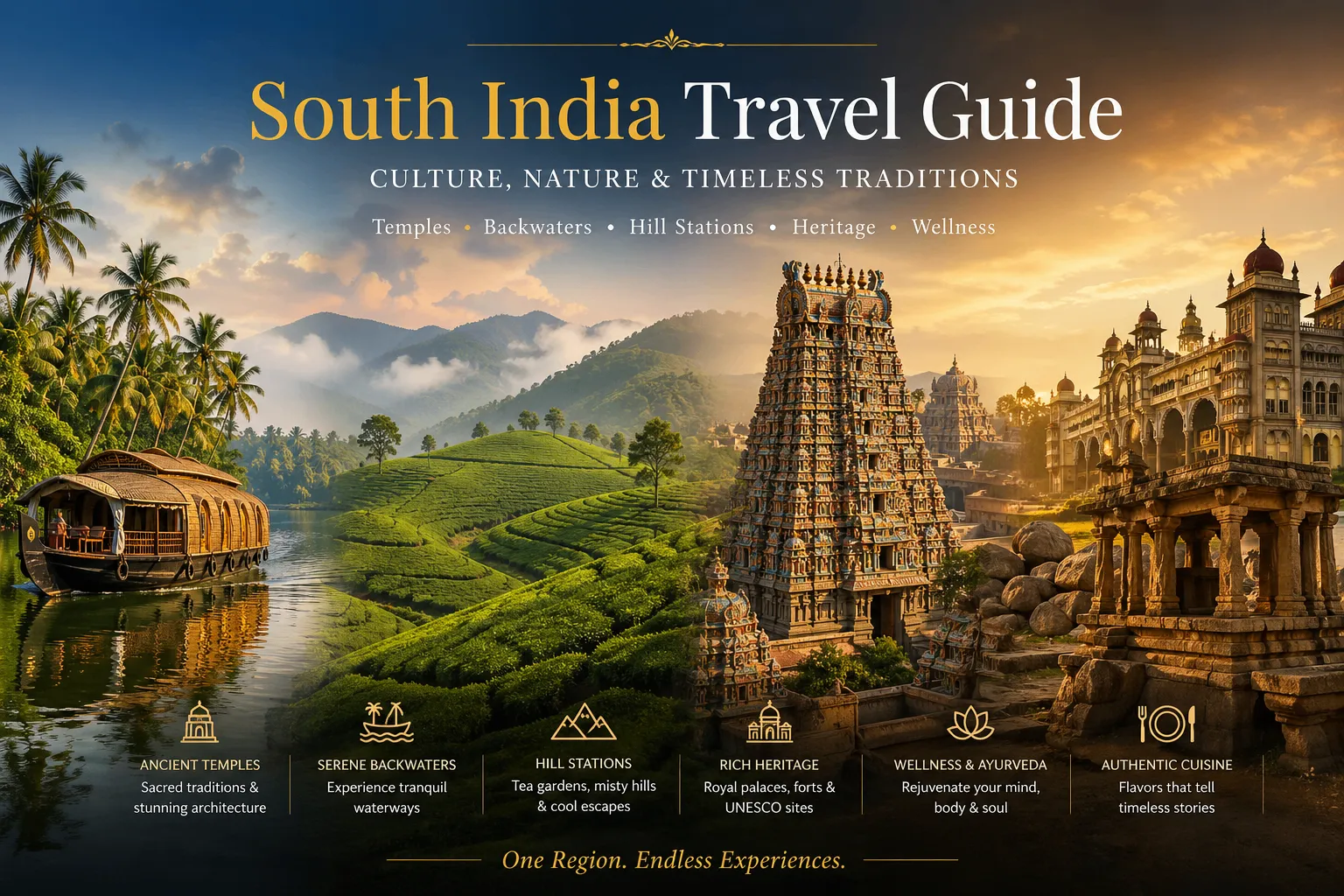
South India Travel Guide –
Culture, Nature & Journeys That Move at Their Own Pace
A practical guide to planning real trips across temples, hill stations, backwaters, wildlife parks, and coastal routes in South India
South India is not a place you rush through. It rewards slower travel, longer stays, and better planning. Most travellers come here for its temples, hill stations, and backwaters, but what they remember later is the rhythm of the region — early temple mornings in Tamil Nadu, winding drives through Karnataka’s Western Ghats, and quiet days along Kerala’s waterways. This guide focuses on how to actually travel through South India in a way that makes sense on the ground — distances, routes, what connects easily, and what doesn’t. It covers Kerala, Tamil Nadu, and Karnataka in a practical circuit style, because those are the three states most travellers combine in a single trip. Andhra Pradesh and Telangana are culturally rich, but usually planned separately unless you’re doing a longer India itinerary.
Explore This South India Travel Guide
Jump directly to the topics that matter most—from iconic destinations and practical travel planning to suggested itineraries, budgeting tips, local customs, and expert advice for exploring South India with confidence.
South India at a Glance
- Temple towns in Tamil Nadu where rituals are still part of daily life, not tourism
- Hill stations like Ooty, Coorg, and Munnar where travel times are longer than maps suggest
- Karnataka’s mix of heritage cities, ruins, and quiet countryside drives
- Kerala’s backwaters and slow-moving village life that needs unhurried days
- Easy access to Ayurveda, yoga retreats, and coastal wellness stays
🌍 Best Places to Visit in South India
Most travellers start South India with a rough list of places — maybe a temple in Madurai, a hill station like Ooty, or Hampi’s ruins. But once the journey begins, the rhythm changes quickly. Distances feel longer, mornings start earlier than expected, and the best experiences often happen between destinations rather than inside them.
Tamil Nadu – Temples, Heritage & Hill Stations
Tamil Nadu is usually where South India feels most immediate. In Madurai, for example, the city doesn’t “show” its temple — it moves around it. Early mornings and late evenings are when the temple truly comes alive, not the middle of the day when most visitors arrive.
- Chennai – Most people pass through quickly, but it’s a practical entry point with easy coastal extensions
- Mahabalipuram – The site feels different in early morning light; after 10 AM it becomes crowded with day visitors from Chennai
- Madurai – The temple is not a monument you “see,” it’s a place you time. Evening rituals are the real highlight, not daytime sightseeing
- Ooty & Kodaikanal – These are not quick escapes. The roads alone can take longer than expected, especially during weekends and monsoon
Karnataka – Heritage Cities, Landscapes & Quiet Routes
Karnataka often surprises travellers because it doesn’t behave like a single experience. One day you’re in royal Mysore, the next you’re driving through open countryside toward Hampi where the landscape suddenly turns ancient and surreal.
- Mysore – The palace is impressive, but the city’s real rhythm shows during early evenings when locals gather around its illuminated streets
- Hampi – This is not a quick sightseeing stop. People often underestimate how spread out the ruins are until they arrive
- Coorg – Travel slows down here. It’s not about what you “see,” but how long you stay in the coffee estates and forest drives
- Badami–Aihole–Pattadakal – Less crowded, but more rewarding if you’re interested in understanding how temple architecture evolved
If there is one planning mistake people make, it’s treating South India like a checklist. It works better when you plan around travel time, not distance — especially between Tamil Nadu and Karnataka circuits.
How Many Days Do You Need for South India?
This is usually the first real planning question travellers ask — and also where most itineraries go wrong. South India looks compact on a map, but travel between places is slower than expected. Roads wind through hills, temple towns require detours, and what looks like a short distance can easily take half a day.
A better way to plan is not by “how many cities you want to see,” but by how much movement you’re comfortable with. The experience changes completely depending on whether you’re rushing or allowing breathing space between regions.
7 Days – A Quick Introduction (Not Ideal, but Possible)
A 7-day trip works only if you stay within one state or a very tight circuit. Most travellers underestimate travel time and end up spending more hours on the road than exploring destinations.
- Best for: Either Tamil Nadu temple circuit OR Karnataka highlights
- Works well if you avoid long hill drives
- Feels rushed if you try to combine multiple states
10 Days – The Most Common First-Time Trip
This is the duration most international and first-time travellers choose, and it works well if planned carefully. You can combine either Tamil Nadu + Karnataka, or Karnataka + a short Kerala extension, but not all three in depth.
The key difference between a good 10-day trip and a stressful one is travel pacing. If you change hotels every night, the trip starts feeling like movement instead of travel.
- Best for: Tamil Nadu + Karnataka circuit
- Includes temples, heritage cities, and one hill station stretch
- Balanced pace if planned with fewer hotel changes
14 Days – The Ideal South India Journey
If there is a “sweet spot” for South India, this is it. Two weeks allow you to experience the contrast that makes the region special — temple towns in Tamil Nadu, heritage cities in Karnataka, and at least one relaxed nature or hill station segment.
At this pace, travel stops feeling like a constraint and starts becoming part of the experience. You also get room for rest days, which most travellers don’t plan but eventually need.
- Best for: Multi-region South India circuit
- Allows proper time in Hampi, Mysore, Madurai, or Coorg
- Includes breathing space between long drives
Most travellers don’t regret seeing “less” in South India — they regret trying to see too much in too little time. The region rewards slower pacing more than packed itineraries.
🌦️ Best Time to Visit South India
The “best time” in South India depends less on temperature and more on how you want to travel. The region behaves differently from north India — distances, humidity, and rainfall patterns all affect how comfortable your journey feels on the ground.
Most travellers end up visiting between October and March, and that is generally the safest window. But even within that period, each state has its own travel rhythm, and the experience can change significantly depending on where you go.
October to March – The Most Reliable Travel Season
This is when most routes feel comfortable — temple visits in Tamil Nadu are easier, hill stations in Karnataka are clear, and Kerala’s backwaters feel calm and pleasant. You still get variation in temperature depending on altitude, but travel itself is smooth.
- Best for: First-time travellers and multi-state itineraries
- Comfortable for temple circuits and long road journeys
- Peak season — hotels and heritage stays need early booking
April to June – Hot, But Not Impossible
Summers in South India can feel intense in the plains, especially in Tamil Nadu and interior Karnataka. However, this is also when hill stations like Ooty, Kodaikanal, and Coorg become more relevant, as travellers shift their focus to cooler regions.
The key here is routing. If your itinerary includes long temple drives in the plains during peak afternoon heat, it becomes tiring. But if planned around hills and shorter travel segments, it still works well.
June to September – Monsoon Travel (Slow but Beautiful)
Monsoon changes the mood of South India completely. Kerala becomes green and atmospheric, Karnataka’s coffee regions feel fresh, and even temple towns take on a slower rhythm. But it is not a fast-moving travel season.
- Best for: Kerala, Coorg, and nature-focused travel
- Not ideal for tight itineraries or long road circuits
- Expect occasional delays due to heavy rain
If there is one practical takeaway, it’s this: South India is not about avoiding seasons — it’s about matching the right route to the right time. A well-planned itinerary can work in almost any month, but a poorly planned one will feel rushed even in peak season.
🚗 How to Travel Around South India
The biggest difference between planning South India and actually travelling it is how movement works between places. Distances on maps rarely reflect real travel time. A 180 km journey can easily take 4–6 hours depending on terrain, traffic, and road conditions.
Most travellers only understand this after the first long drive — especially in routes connecting Tamil Nadu, Karnataka, and Kerala where highways often transition into winding hill roads without warning.
Road Travel – The Most Flexible Way to Explore
Most South India itineraries are designed around private road travel. Not because it is luxurious, but because it gives flexibility. Temple towns, hill stations, and heritage sites are often spread out, and schedules rarely match fixed transport timings.
- Best for: Multi-city itineraries across Tamil Nadu, Karnataka, and Kerala
- Allows stops in smaller towns and viewpoints along the way
- Travel time is longer, but control over pace is much better
Trains and Flights – Useful, But Limited for Full Circuits
Trains in South India are reliable for point-to-point travel between major cities like Chennai, Mysore, and Coimbatore. Flights help cover long gaps quickly, especially if you are entering or exiting the region. But neither option works smoothly for sightseeing circuits on their own.
This is why most well-planned itineraries combine flights for entry/exit and road travel for everything in between.
What Most Travellers Underestimate
- Hill station drives take longer than expected due to curves and traffic
- Temple visits often involve timing around rituals, not just entry
- Changing hotels frequently reduces actual sightseeing time
- Google Maps estimates are often optimistic in rural stretches
The most successful South India trips are not the ones that cover the most places — they are the ones that respect travel time. Once the routing is correct, everything else becomes much easier to enjoy.
💰 South India Travel Cost (What to Expect in Reality)
One of the most common questions travellers ask is about budget, but in South India the answer is never a single number. Costs depend heavily on how you travel — especially your choice of hotels, transport style, and how much moving around your itinerary involves.
A well-planned trip here is not about spending the least, but about avoiding unnecessary travel inefficiencies — like long detours, frequent hotel changes, or poorly connected routes that increase both time and cost.
Budget Travel – Simple Stays & Public Transport Focus
Budget travel is possible in South India, especially if you stick to major cities and use trains or buses. However, it becomes more challenging when you move into hill stations or remote temple circuits where connectivity is limited.
- Best for: Solo travellers and backpack-style trips
- Works well in Chennai, Madurai, Mysore, Bengaluru routes
- Less flexible for remote or multi-region itineraries
Mid-Range Travel – The Most Practical Option
This is where most travellers naturally end up. Clean hotels, private transfers, and a balanced itinerary make the experience smoother without becoming overly expensive. It also reduces stress around logistics, especially when covering multiple destinations.
The biggest advantage here is time efficiency — you spend more of your day exploring rather than figuring out how to move between places.
Luxury Travel – Comfort, Space & Better Pacing
Luxury travel in South India is not just about hotels — it’s about pacing. Heritage stays in Mysore, plantation resorts in Coorg, and backwater villas in Kerala change the rhythm of the entire journey.
When planned properly, luxury travel here often feels less rushed, because routes are designed with longer stays instead of frequent movement.
In most cases, travellers don’t overspend in South India — they overschedule. Reducing the number of stops usually improves both experience and overall cost efficiency.
Suggested South India Itineraries
Planning an itinerary in South India is less about covering destinations and more about building a logical route. The region doesn’t reward fast movement — it rewards well-paced travel with fewer but meaningful stops.
The itineraries below are based on real travel flow between Tamil Nadu, Karnataka, and Kerala. Kerala is often added as a finishing or slow-travel segment because of its backwaters and relaxed pace, while Tamil Nadu and Karnataka usually form the cultural and heritage backbone of the journey.
7 Days – Focused Regional Trip (Not a Full South India Circuit)
- Tamil Nadu focus: Chennai → Mahabalipuram → Madurai
- Karnataka focus: Bengaluru → Mysore → Coorg
- Kerala is generally not included at this stage unless you convert the trip into a single-state Kerala-only experience
In 7 days, the mistake most travellers make is trying to squeeze Kerala, Tamil Nadu, and Karnataka together. Kerala alone deserves time because of slower backwater travel and longer coastal movement.
10 Days – Balanced South India Introduction
- Option 1 (Most common): Tamil Nadu + Karnataka
- Chennai → Mahabalipuram → Madurai → Mysore → Coorg
- Option 2 (Kerala extension style): Mysore → Wayanad → Cochin (Kerala entry point)
Kerala usually works better as a natural extension at this stage — especially Wayanad or Cochin — rather than trying to cover the full backwater circuit in a short itinerary.
14 Days – Proper South India Experience
- Chennai → Mahabalipuram → Madurai → Mysore → Hampi → Coorg → Kerala (Alleppey / Thekkady / Cochin)
- Kerala is best experienced in the second half of the journey when travellers are ready to slow down
- Combines heritage (Tamil Nadu + Karnataka) with slow travel (Kerala backwaters)
Kerala changes the rhythm of the entire trip. After temple towns and heritage cities, it brings a slower pace — houseboats, backwaters, and plantation stays — which balances the intensity of the earlier part of the journey.
🧳 Planning Your South India Journey
By the time most travellers finish reading about South India, the challenge is no longer deciding where to go — it’s figuring out how to put everything together in a way that actually works on the ground.
The region has a natural flow, but it’s easy to disrupt that flow by trying to fit too many places into a short trip or by underestimating travel time between destinations. The result is usually more time on the road and less time experiencing the places themselves.
Temple Etiquette & Cultural Tips in South India
Temples are not just sightseeing stops in South India — they are active places of worship where daily rituals, prayers, and traditions continue as part of normal life. Understanding a few basic customs helps you experience them with more respect and ease.
Dress Code Matters More Than Expected
Most major temples in Tamil Nadu, Karnataka, and Kerala expect modest clothing. Men are often required to remove shirts in certain temples, and women are expected to wear clothing that covers shoulders and knees. Carrying a simple shawl or scarf can be very useful during temple visits.
Footwear is Always Removed
Shoes are not allowed inside temple premises. Most temples have designated footwear stands near entrances. It’s best to travel with easily removable footwear since you may visit multiple temples in a single day.
Photography Rules Vary by Temple
Some temples allow photography in outer courtyards, while others restrict it completely inside the main sanctum areas. It’s always better to observe signage or ask local staff before taking photos.
Quiet Observation is Expected Inside Sanctum Areas
Temples are active spiritual spaces, so speaking softly and following the flow of devotees is important. In larger temple towns like Madurai or Thanjavur, you may also see rituals happening throughout the day rather than at fixed times.
Once you understand temple etiquette, visits become far more meaningful. Instead of feeling like a checklist stop, temples in South India start to feel like living cultural spaces where travel and tradition naturally overlap.
⚠️ Common Mistakes Travellers Make in South India
Most South India trips don’t fail because of the destinations — they fail because of planning assumptions. The region is very rewarding, but only when the routing and pacing match how travel actually works on the ground.
Trying to cover too many places in too few days
This is the most common issue. South India looks compact on a map, so travellers often try to combine Kerala, Tamil Nadu, and Karnataka in a short trip. In reality, travel time between destinations reduces actual sightseeing significantly.
Underestimating travel time between destinations
A 150–200 km journey can easily take several hours due to winding roads, hill sections, and temple town traffic. Many itineraries break down simply because they are built on distance, not driving time.
Changing hotels every night
Frequent hotel changes sound efficient on paper but often lead to fatigue in South India. A better approach is to base yourself in fewer locations and explore surrounding regions from there.
Ignoring temple timings and local schedules
Many travellers arrive at temples expecting flexible entry, but in reality, temple towns operate on fixed rituals and timings. Missing a key ceremony often changes the entire experience.
Treating Kerala, Tamil Nadu, and Karnataka as similar experiences
Each state has a completely different travel rhythm. Kerala is slow and nature-focused, Tamil Nadu is structured and temple-driven, and Karnataka blends heritage with varied landscapes. Mixing expectations often leads to planning confusion.
Most of these issues are not about travel difficulty — they are about routing and pacing decisions made before the trip begins. Once those are correct, South India becomes one of the most comfortable regions to explore.
When a Custom Plan Makes a Difference
A well-structured itinerary is not just about listing destinations — it’s about sequencing them correctly, balancing travel distances, and matching the route with the season and travel style.
- Choosing between Tamil Nadu + Karnataka or adding Kerala as a slow-travel extension
- Reducing unnecessary hotel changes and long backtracking routes
- Aligning temple timings, hill station stays, and travel durations realistically
Plan It the Way Experienced Travellers Do
Most repeat travellers to South India don’t follow fixed templates — they adjust routes based on timing, pace, and personal interests. That flexibility is often what makes the journey feel smooth instead of rushed.
If you are planning a first-time or multi-state trip, having a properly structured route can make a significant difference in how the journey feels day to day.
South India is not difficult to travel — it just needs the right sequence. Once the routing is clear, the experience becomes far more relaxed, immersive, and enjoyable.
Frequently Asked Questions
What is the best month to visit South India?
The most reliable travel period is October to March. During these months, temple visits, hill station travel, and coastal routes are all comfortable. Summer is manageable in hill regions, while monsoon is best for slow nature-based travel in Kerala and Karnataka.
Which is better for a South India trip — Kerala or Tamil Nadu?
They offer very different experiences. Tamil Nadu is more about temples, heritage, and structured sightseeing, while Kerala is slower, more scenic, and focused on backwaters and nature. Most balanced itineraries include both, depending on travel time.
Is South India expensive to travel?
South India can suit different budgets. Budget travel is possible with trains and basic stays, but most travellers choose mid-range or private travel because it reduces fatigue and improves routing between destinations.
Can South India be covered by train only?
Trains work well between major cities like Chennai, Mysore, and Coimbatore, but they are not ideal for full sightseeing circuits. Many important destinations like hill stations and heritage sites require road travel for flexibility.
How many states should I include in a South India itinerary?
Most well-planned itineraries include two to three states — usually Tamil Nadu, Karnataka, and sometimes Kerala. Trying to cover all regions in a short trip often leads to excessive travel time and a rushed experience.
Is South India safe for tourists?
Yes, South India is generally considered very safe for travellers. Standard travel precautions apply, but most tourist circuits are well-established and frequently visited by both domestic and international travellers.
Do I need a guide for South India?
A guide is not mandatory, but it can improve the experience in places like temple towns, heritage sites, and cultural circuits where context adds meaning. For multi-city trips, structured planning is often more important than guided sightseeing.
What type of travellers enjoy South India the most?
South India suits travellers who prefer culture, heritage, nature, and slower-paced journeys. It is especially popular with families, couples, and first-time India visitors looking for a balanced and comfortable travel experience.
🌺 Continue Exploring South India 🌺
Experience the incredible diversity of South India through private sightseeing tours featuring ancient temples, colonial towns, misty hill stations, tranquil backwaters, royal cities, and remarkable UNESCO World Heritage Sites.
India Tour Packages
Explore our most popular private India tours designed for comfort, culture, and seamless travel experiences.